Journalistic: a rewrite style that writes like a news desk

Private Writing Assistant
Check grammar and rewrite text with AI that runs on your device. Free.
 Add to Chrome
 Add to Safari
A press release says the chief executive “proudly announced” a “game-changing” deal. A reporter turns that into “said” and lets the facts do the work. Journalistic, the newest rewrite style in Private Writing Assistant, makes the same moves on your draft.
In short
Journalistic is a rewrite style for news writing in Private Writing Assistant. Select a sentence or a paragraph, click Rewrite and pick Journalistic: the draft comes back in neutral news style, with plain speech verbs, without loaded words, and with your language's own rules for reported speech and quotation marks. It never invents a source or a quote, and it runs with Chrome Built-in AI on your computer.
Find it in the list of styles
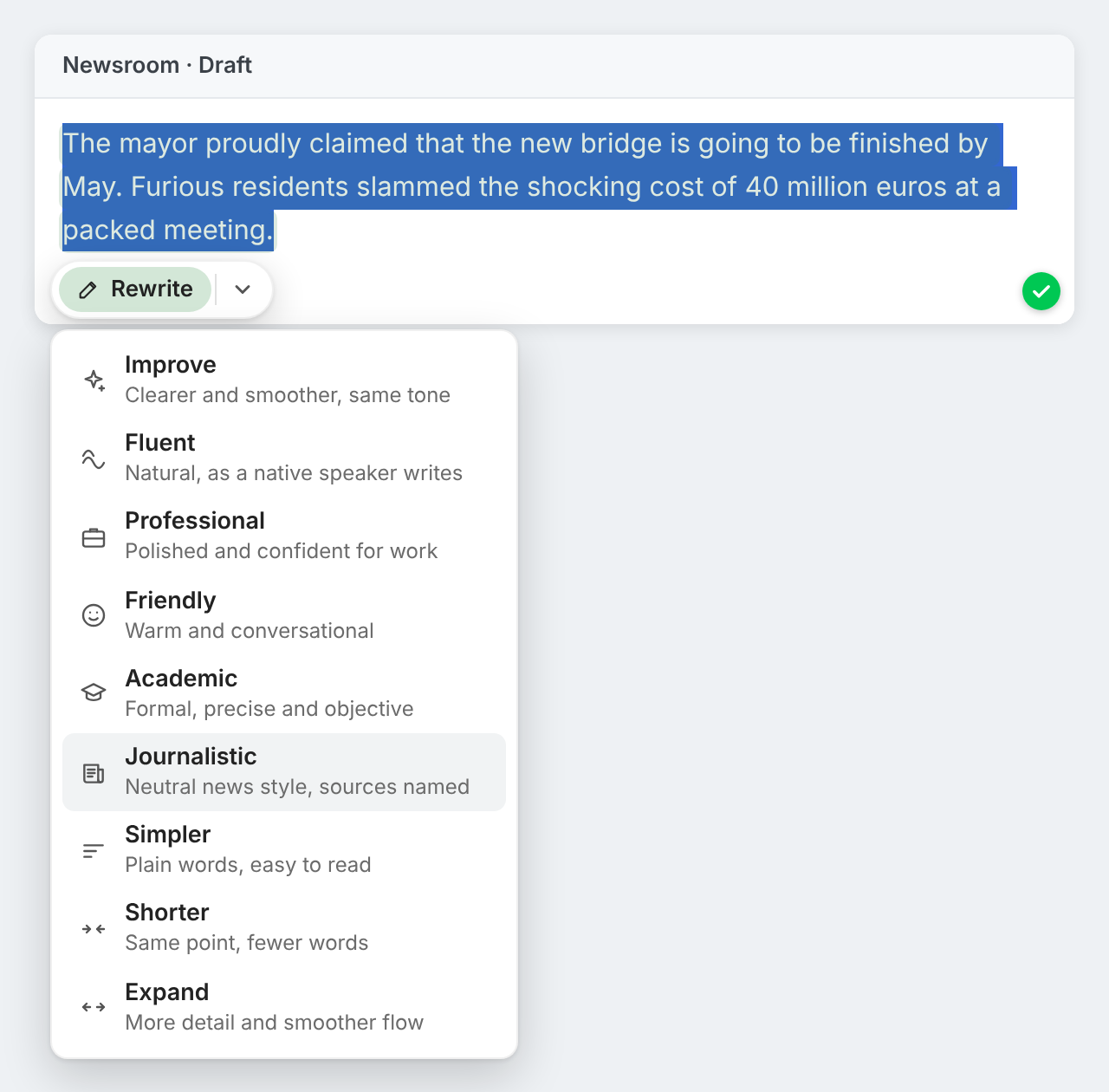
Select the text, click Rewrite, and pick Journalistic, right after Academic. The card shows the rewrite with every change marked, so you can see what moved before you click Replace. Like the other styles, it moves up the list as you use it.
Three sentences taken apart
Each of these is a real habit of hurried drafts. Here is what the style changes, and why.
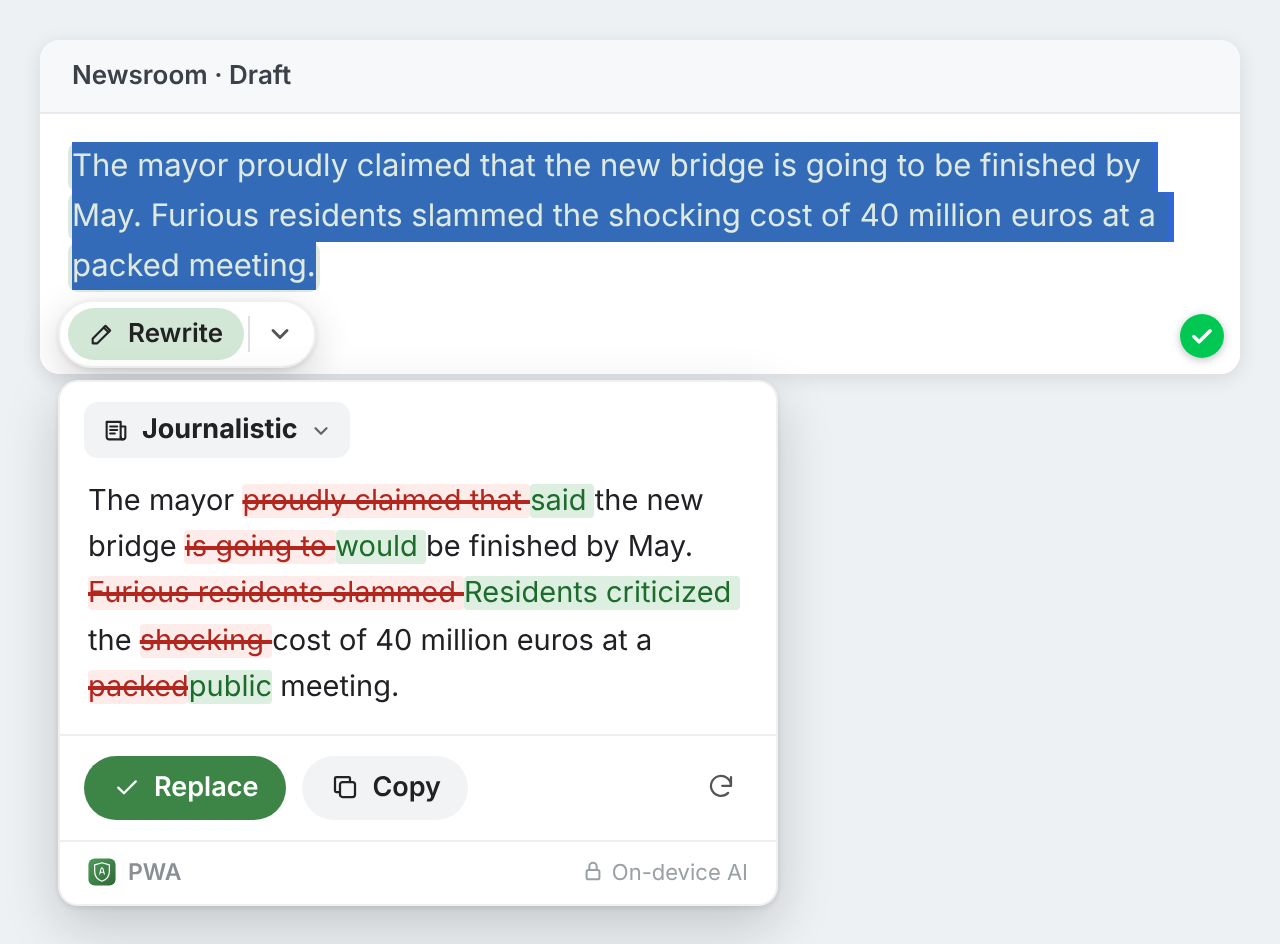
Speech verbs that take sides. “Claimed” hints the speaker is lying, “admitted” that they had something to hide. News style uses the neutral verb and keeps the time of what was said.
The mayor proudly claimed that the new bridge is going to be finished by May.
The mayor said the new bridge would be finished by May.
Words that judge for the reader. “Shocking”, “slammed” and “furious” tell readers what to feel; the number tells them what happened.
Furious residents slammed the shocking cost of 40 million euros at a packed meeting.
Residents criticized the cost of 40 million euros at a public meeting.
Reported speech by your language's rules. German news writing puts reported statements in the subjunctive, so the reader knows it's the minister's claim, not the paper's. The style follows each language's own conventions where they differ from everyday writing.
Der Minister hat gesagt, dass die Lage stabil ist.
Der Minister sagte, die Lage sei stabil.
What it leaves alone
A news style that invents things would be worse than none, so the style is strict about what it may not touch:
- It never adds a source, a speaker, a quote or a fact that isn't in your text, and never turns your own statement into someone else's.
- Doubt stays exactly where you put it. “Reportedly” and “according to” stay; a claim you state plainly doesn't get a hedge.
- Direct quotes stay word for word.
- Your point of view and your form of address stay as they are.
Quotation marks the way newspapers print them
Different languages put quotes in different marks: „…“ in German, «…» in French, 「…」 in Japanese. After a Journalistic rewrite, Private Writing Assistant sets the quotation marks your language's newspapers use, in 85 languages, and follows regional habits, such as «…» in Swiss German.
For anyone who writes the news
Reporters on deadline, press officers turning a release into something an editor will run, people who write a club newsletter or a company update: anyone whose text should read as fact rather than opinion. The style works in each of the 101 languages Private Writing Assistant checks.
An unpublished story stays unpublished
Journalistic runs with Chrome Built-in AI on your own computer, like every other style. The draft you rewrite is never sent to us or to any third party, such as an AI service, which matters when it holds a source's words or a story before it runs. There's no account to sign up for, so we don't know who you are. Usage stats, unless you switch them off, record which style was picked and how many sentences, never the text. How it works has the details.
Next time a draft reads like a press release, select it, click Rewrite and pick Journalistic. Private Writing Assistant is free to add to Chrome.